Tenpai · Understanding Mahjong
Flowers and seasons
Eight bonus designs bring plants and the cycle of the year into the Mahjong set. Their cultural meanings are separate from their roles in play.
The Four Gentlemen
Plum, orchid, chrysanthemum and bamboo are known in East Asian art as the Four Gentlemen. Plants are understood as expressing human qualities: endurance, quiet dignity, independence, or flexibility combined with strength of character. Mahjong's flowers draw on this familiar group of subjects. Their cultural associations with seasons are separate from the tiles' numbering; the associations also differ between artistic traditions.
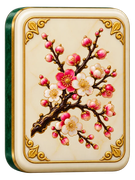
Plum Blossom
Plum is one of the Four Gentlemen of East Asian art. Its blossom is associated with strength in adversity: beauty and vitality appear even when its surroundings may still be bare. The plant thus becomes a model for a person who maintains their integrity. In one common seasonal interpretation, it represents winter or the transition to new growth. This artistic tradition gives the small flower tile a much broader background than simply naming a blossom.
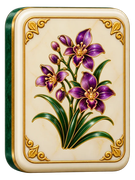
Orchid
In Chinese scholar-painting, the orchid represents inner quality. Museums explain it through modesty, loyalty and virtue that may go unnoticed. This fits the image of a flower whose subtle appeal rewards a close look. As one of the Four Gentlemen, it shifts attention from outward splendour to character. The Mahjong tile carries this cultural connection into an everyday game.
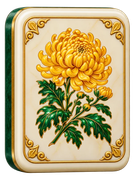
Chrysanthemum
In East Asian art, the chrysanthemum is a flower of autumn. It is particularly associated with the poet Tao Yuanming, who celebrated life away from official duties and worldly ambition. It can therefore represent freely chosen simplicity and inner independence. As one of the Four Gentlemen, it adds to the plum's steadfastness and the orchid's quiet dignity the idea of someone choosing their own path through life.
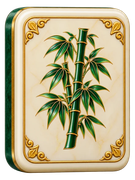
Bamboo · Flower tile
As one of the Four Gentlemen, bamboo represents a person who remains both strong and flexible. Its upright form and bending stem make that idea visible. Art also associates it with openness of mind. Here, bamboo therefore appears as the character image of an entire plant. This is a different layer of meaning from the numbered suit of the same name, whose predecessors were strings of coins.
Spring, summer, autumn and winter
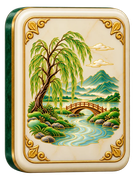
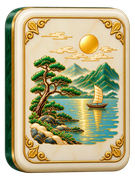
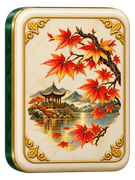
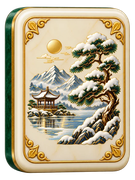
Spring, summer, autumn and winter form a small complete world within the tile set: beginnings, growth, maturity and rest. Their Chinese names 春、夏、秋、冬 already appear in early documented sets. Later makers depict the year through blossoms, landscapes or other designs. These four tiles form a separate bonus group alongside the four flowers. In table Mahjong, such bonus tiles may be displayed face up and replaced by a newly drawn tile.
Flowers and seasons are two separate groups. A cultural association between a plant and a season therefore does not make the two game tiles identical.
What is their role at the Mahjong table?
In some classic rules, drawn flowers and seasons are displayed face up and replaced with a new tile. They may receive special scoring. Whether and how this happens depends on the rules being played; it is not a general rule for every Mahjong game.
The rule in Tenpai
The Solitaire layouts use Orchid and Winter. Both designs are treated like the other tile identities: Orchid matches only Orchid, and Winter only Winter. You cannot simply remove two different flowers together.
Plum, Chrysanthemum and Bamboo, as well as Spring, Summer and Autumn, appear in the gallery but are not used in these Tenpai layouts. Looking at them helps you get to know the full system of designs.
Sources and context
These background texts distinguish documented tile history, linguistic meaning and the rules of today's game.
- Walters Art Museum · The Four GentlemenObject 51.345: this theme, which travelled from China to Japan, comprises plum, orchid, bamboo and chrysanthemum. In this work they correspond to winter, spring, summer and autumn.
- Cleveland Museum of Art · Plants and characterYamamoto Baiitsu, 1834, object 1975.93: plum as strength in adversity, orchid as modesty and bamboo as openness of mind.
- Metropolitan Museum of Art · Orchid and bambooZheng Xie, 1742, object 1981.285.7: orchid as loyalty and unrecognised virtue; bamboo as a noble person who is both strong and flexible.
- Asian Art Museum · Tao Yuanming and the chrysanthemumHuang Yongyu, 1983, object 1994.119: the chrysanthemum's association with the poet Tao Yuanming and his withdrawal from worldly life.
- Michael Stanwick · Seasons in early setsSection 1 reconstructs the set acquired by Himly between 1868 and 1876: it already includes 春、夏、秋、冬. Section 2 describes later design variants.
- A Guide to Mahjong · Table play and tile typesGuide hosted by the Mahjong International League, especially pp. 7–9, 15–17 and 22: suits, bonus tiles, combinations, and scoring for dragons and seat/round winds. Describes one rules variant, not Tenpai Solitaire.