Tenpai · Understanding Mahjong
The Mahjong tiles
The designs tell stories of money, directions and nature. Their meanings explain the pictures; Tenpai's rule stays simple: two free tiles with the same identity make a pair.
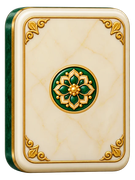
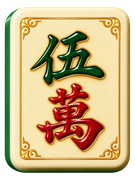
Three numbered suits
Circles, Bamboo and Characters each have nine ranks. Their origins lead back to older Chinese money-suited playing cards: coins, strings of coins and large monetary units. Today's designs range from simple dots to elaborate rosettes and plants.
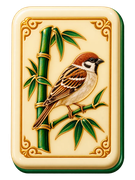
The same number alone does not make a pair: Circles 3 and Bamboo 3 belong to different suits. The bird is the one of the Bamboo suit.
Honour tiles: four winds and three dragons
East, South, West and North form a group of directions. Red, Green and White name the three dragons. These seven tile types are called honour tiles in classic table Mahjong; they have no numerical sequence.
The wind names also serve a practical purpose at the Mahjong table: they name seats and rounds. The name “Dragon”, meanwhile, is not simply a translation of the Chinese characters.
Flowers and seasons
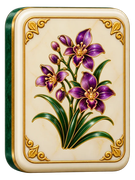
Plum, orchid, chrysanthemum and bamboo draw on a familiar group of subjects in East Asian art. Spring, summer, autumn and winter form a separate group of bonus tiles. In table Mahjong, particular procedures may apply to them, depending on the rules.
From these groups, Tenpai uses Orchid and Winter. Orchid matches only Orchid, and Winter only Winter. You can view the other designs in the gallery.
One tile, three designs


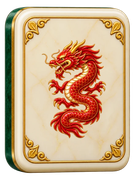
KIRI, Exklusiv and Jade depict the same tile identities in different visual styles. The Red Dragon is a clear example: the written character and the animal illustration represent the same tile here. Choose your set under “Appearance” at the game table, where you can also open the full tile gallery.
Sources and context
These background texts distinguish documented tile history, linguistic meaning and the rules of today's game.
- Michael Stanwick · From money cards to MahjongOriginal research, sections 1–3: coins, strings of coins and myriads in card and tile sets. Mahjong's exact place and date of origin remain uncertain.
- Michael Stanwick · The earliest suit namesOriginal research into the names, particularly 索 as a string of coins and 萬 as a myriad. The historical number of coins per string was not the same everywhere.
- Michael Stanwick · Early winds and honour tilesSection 3.3.2 compares 中 as centre with 中 as hitting the mark and documents the group 中、發、白 in the 1889/90 set. Section 3.5 discusses the 1909 set.
- A Guide to Mahjong · Table play and tile typesGuide hosted by the Mahjong International League, especially pp. 7–9, 15–17 and 22: suits, bonus tiles, combinations, and scoring for dragons and seat/round winds. Describes one rules variant, not Tenpai Solitaire.
- Walters Art Museum · The Four GentlemenObject 51.345: this theme, which travelled from China to Japan, comprises plum, orchid, bamboo and chrysanthemum. In this work they correspond to winter, spring, summer and autumn.