Tenpai · Understanding Mahjong
The Red Dragon in Mahjong
A name from a mythical creature, yet many tiles show only a red written character. The Red Dragon's name, image and history do not quite coincide.


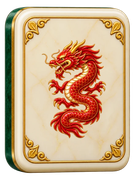
What does the character 中 mean?
The red tile traditionally bears 中. Read as zhōng, it means “middle” or “centre”; read as zhòng, it can mean “hit”, “obtain” or “pass an examination”. This suggests the vivid idea of reaching a target. “Red Dragon”, by contrast, is the common Western tile name, not a literal translation of 中. 發 and the white tile 白 belong to the same group. Looking for three mythical creatures in them means starting with the later group name; the Chinese characters themselves first lead to separate words and meanings.
The different readings in Taiwan's Ministry of Education dictionary
Why is this tile part of the game?
Early documents already explain 中 in different ways: Glover understood the tile as the centre and a fifth direction, while Wilkinson later described it as “hitting the mark”. In Wilkinson's 1889/90 set it forms a group of three with 發 and White. This explains its place in Mahjong's developing structure without claiming a single inventor's reason. Historical sets also used 龍, the actual character for dragon, and 鳳 for phoenix. Modern designs likewise use dragon pictures; the familiar red 中 tile, however, shows the written character.
Its place in the game can therefore be described historically: the red tile is part of a documented group of honour tiles. These sources do not establish one certain story explaining why an inventor added this particular tile.
What does the Red Dragon do in classic Mahjong?
The Red Dragon is an honour tile. Three identical tiles form a triplet and four a quad; Red, Green and White do not form a sequence. Many table rules award a special score for a dragon triplet or quad, regardless of the player's seat wind.
The exact scoring depends on the Mahjong rules being used. What remains the same is the tile's distinct identity: Red is neither a number nor an interchangeable substitute for another dragon.
How do you play it in Tenpai?
Pair it with a second free Red Dragon. Green and White Dragons do not match it. There is no extra dragon bonus.
In KIRI and Exklusiv, look for the continuous central stroke. In Jade, the red body colour and the complete dragon figure distinguish it.
The dragon name gives it no special power here. The same rules for free tiles apply as for every other pair: uncovered on top and free on the left or right.
What about Green and White?
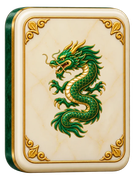
The green tile traditionally bears 發. Its meaning is particularly accessible through 發財, fācái: to acquire wealth or become rich. This is why the tile is often associated with prosperity. The individual character has a broader range of meanings, however; early descriptions also translated it in the sense of “setting off”. The Western name “Green Dragon” groups it with the red and white honour tiles.
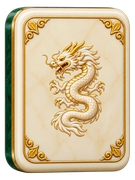
For the white tile, the absence of a large written character is significant. Its Chinese name 白, bái, means white; its blank, light surface is its defining feature. A frame may outline this surface. Alongside the written characters 中 and 發, there is thus a tile defined by emptiness or whiteness. The Western name “White Dragon” also gives it an animal identity, although its traditional face is often completely unillustrated.
The three form a family, but not a mixed pair. A White Dragon is not a joker either.
Sources and context
These background texts distinguish documented tile history, linguistic meaning and the rules of today's game.
- Taiwan Ministry of Education · 中Dictionary: zhōng includes middle/centre; zhòng includes hitting, obtaining and passing an examination. These readings must be distinguished.
- Michael Stanwick · Early winds and honour tilesSection 3.3.2 compares 中 as centre with 中 as hitting the mark and documents the group 中、發、白 in the 1889/90 set. Section 3.5 discusses the 1909 set.
- Michael Stanwick · Dragon and phoenix as older variantsSection 4.1 documents 龍 (dragon) and 鳳 (phoenix) as alternatives to 中 and 發. The Western group name must be distinguished from these individual Chinese designs.
- A Guide to Mahjong · Table play and tile typesGuide hosted by the Mahjong International League, especially pp. 7–9, 15–17 and 22: suits, bonus tiles, combinations, and scoring for dragons and seat/round winds. Describes one rules variant, not Tenpai Solitaire.
- Taiwan Ministry of Education · 發財Dictionary: 發財 (fācái) means to acquire wealth. Supports the linguistic connection between the green tile and prosperity.
- Unicode · Names of Mahjong tilesReference for the separate tile identities, including flowers, seasons and the tile back; not a historical or cultural interpretation.