Tenpai · Understanding Mahjong
Circles, Bamboo and Characters
The three numbered suits share a historical background: older Chinese money-suited playing cards. Symbols of money became familiar tile designs.
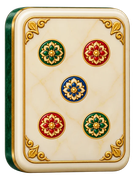
Circles: coins become ornaments
Behind the circles lies the coin suit of older Chinese playing cards. Their round shape preserves the connection with money, even when modern designers turn them into coloured dots, rings or elaborate rosettes. Together with strings of coins and myriads, this suit forms the historical basis of the three Mahjong suits. Each number gives a rank within the suit; this does not imply a separate traditional symbolic story for every rank.
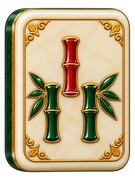
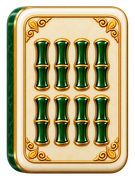
Bamboo: remembering strings of coins
The Bamboo suit leads into Mahjong's monetary history. Chinese coins with holes could be threaded onto strings; these strings of coins formed a suit of early playing cards. Their elongated symbols were transferred to tiles and eventually depicted as bamboo sticks. The name 索, suǒ, preserves the connection with string. Ranks 1 to 9 share this origin. The number of coins on an actual string varied with time and place.
Why is Bamboo 1 a bird?
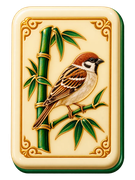
The bird occupies a surprising place: it is the one of a numbered suit. Historically, that suit represents strings of coins; the animal is a later pictorial feature of its first rank. The change from a money symbol to a living bird shows how freely a Mahjong tile's design could develop. No single bird species is prescribed for all sets.
A bird on the one is already documented in a museum set acquired in Shanghai in 1909. That evidence does not establish exactly when or why it replaced the older design.
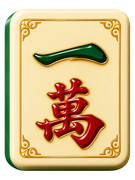
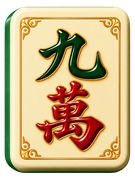
Characters: the suit of myriads
萬, wàn, means ten thousand; “myriad” is another word for it. Together with the number above it, the characters form expressions from ten thousand to ninety thousand. This suit particularly clearly preserves the writing on early money-suited cards. Historically, its large units referred to money or strings of coins. The precise amount depended on the particular old card system. In Mahjong, this became a fixed suit of nine ranks.
What the number means in play
In classic Mahjong, consecutive numbers within the same suit can form a sequence, such as Bamboo 1–2–3. Identical tiles can form groups. The exact composition of a valid hand follows the particular table rules.
In Tenpai Solitaire, you look only for matching free pairs. Bamboo 3 + Bamboo 3 matches. Bamboo 3 + Circles 3 does not match. A red stem in a Bamboo tile's picture does not change its suit.
A tile's numerical rank does not automatically imply a particular historical symbolic story. The documented origins explain primarily the three suits and their forms.
Sources and context
These background texts distinguish documented tile history, linguistic meaning and the rules of today's game.
- Michael Stanwick · From money cards to MahjongOriginal research, sections 1–3: coins, strings of coins and myriads in card and tile sets. Mahjong's exact place and date of origin remain uncertain.
- Michael Stanwick · The earliest suit namesOriginal research into the names, particularly 索 as a string of coins and 萬 as a myriad. The historical number of coins per string was not the same everywhere.
- Penn Museum · Mahjong set from 1920–1923Object 68-3-1.2: museum evidence for the three money suits, winds, dragons and both groups of bonus tiles in an early American set.
- Academia Sinica · 萬Character database: 萬 denotes ten thousand and can also express a very large quantity; the basis for reading the Characters suit.
- Michael Stanwick · Historical tile galleriesIntroduction to Gallery 2.0: the Culin set acquired in Shanghai in 1909 already has a bird on the one of the coin-string suit.
- A Guide to Mahjong · Table play and tile typesGuide hosted by the Mahjong International League, especially pp. 7–9, 15–17 and 22: suits, bonus tiles, combinations, and scoring for dragons and seat/round winds. Describes one rules variant, not Tenpai Solitaire.